Forensic Investigation Consultant FIC
Forensic Investigation Consultant

FORENSIC EXPERT WITNESSES
FORENSIC ANALYSTS
Forensic Investigation Consultant FIC
Forensic Investigation Consultant
FORENSIC EXPERT WITNESSES
FORENSIC ANALYSTS
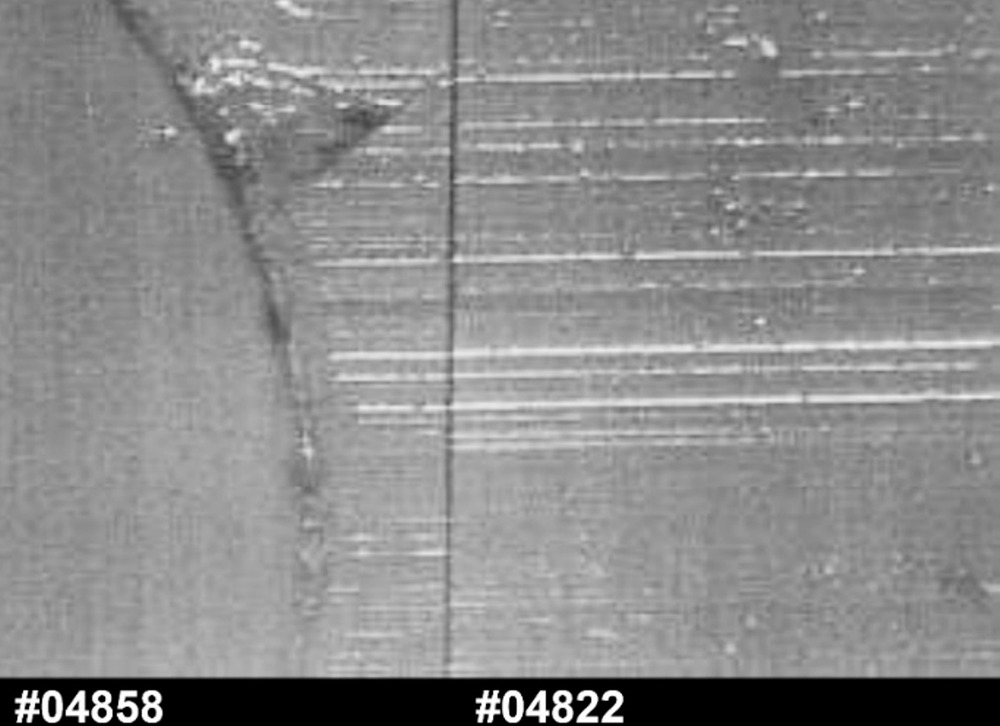
|
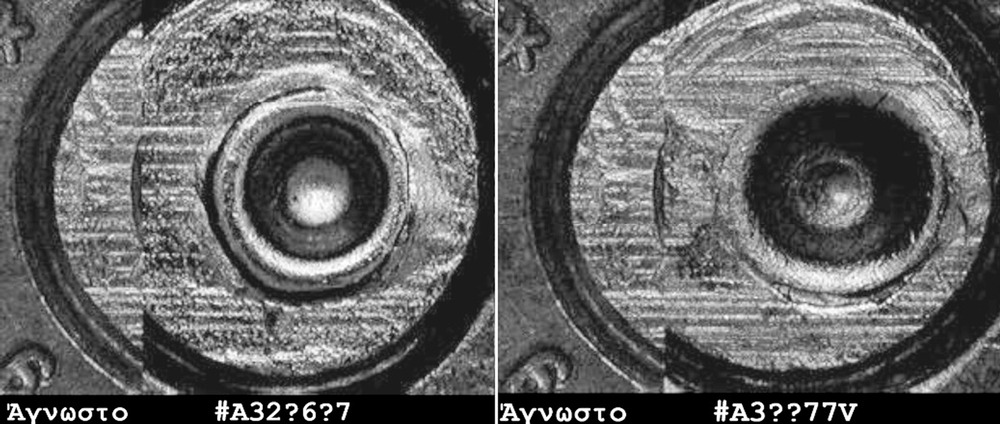
|
For forensic comparison and identification examinations to be recognized as scientifically reliable, admissible and acceptable, they must be conducted using scientific methods capable of consistently producing the same results.
The procedures currently followed and their scientific basis are critically important to the contribution of physical evidence to the formation of judicial reasoning and to the role that such evidence plays in a court’s decision.
Examiners worldwide are under increasing pressure to make more objective identifications.
Law and science first converged on the issue of expert testimony in 1997. On 31 August 2004, an ENFSI Working Group (European Network of Forensic Science Institutes) established scientific identification criteria in the field of forensic science.
On 20 September 2016, the President’s Council of Advisors on Science and Technology (PCAST), an advisory body composed of leading scientists, issued the report Forensic Science in Criminal Courts: Ensuring Scientific Validity of Feature-Comparison Methods. The report recommended measures to promote the valid and evidence-based use of forensic science in courtrooms.
Ideally, every laboratory examination should reflect reality: when a problem exists it should detect it and return a positive result, and when everything is in order it should return a negative result. In practice, however, no laboratory examination is perfect in this way.
Every laboratory method contains a rate of error. Method error is characterized as random when it results from statistical variation, and as systematic when, for various reasons, the method itself cannot determine the measured quantity precisely.
When interpreting results, therefore, two types of erroneous outcome may arise:
To compare laboratory analyses and determine which provides the most reliable results, the terms sensitivity and specificity are used.
The sensitivity of a laboratory examination concerns its ability to detect positive results correctly. A highly sensitive examination therefore produces as few false-negative results as possible. Conversely, specificity concerns the ability to identify negative results correctly. A highly specific examination therefore produces as few false-positive results as possible.
The accuracy of a laboratory examination concerns whether it combines high sensitivity with high specificity. In practice, however, these two measures often vary inversely.
Examinations with high sensitivity may have lower specificity, and vice versa. Depending on the case, the expert must choose the appropriate balance between sensitivity and specificity.
For example, suppose that evidence from a case is searched against an open-case database. A test with high sensitivity must be used so that all potential matches are detected.
Some items may be classified incorrectly as matching, but at that screening stage this is less important because the primary objective is not to miss a potentially related open case.
When a decision is later made to communicate the positive result to the requesting authorities, the test must be repeated using a second examination with high specificity, so as to minimize the possibility of a false-positive result. Avoiding unjustified hardship to an innocent person is as important as the proper administration of justice.
Sensitivity and specificity are estimated quantitatively by means of the following fourfold table:
| Identification | No identification | |
|---|---|---|
| Positive examination | α | β |
| Negative examination | γ | δ |
Therefore, where:
Sensitivity is calculated from the ratio α / (α+γ) and is usually expressed as a percentage.
Specificity is calculated from the ratio δ / (β+δ) and is usually expressed as a percentage.
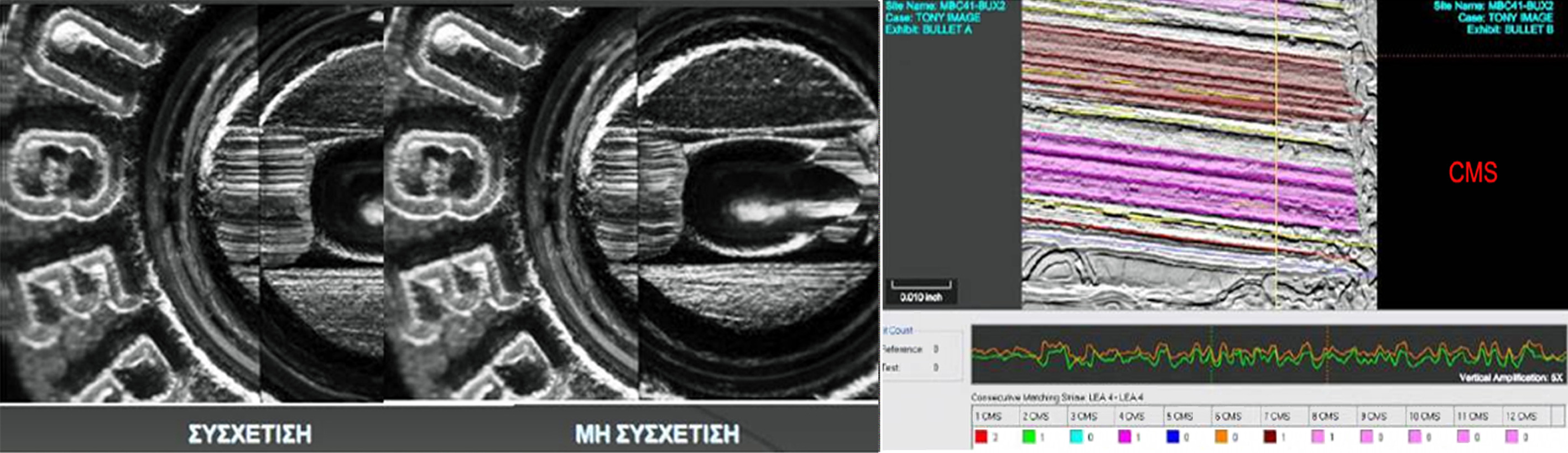
To address these issues, methods based on specialized mathematical criteria and pattern recognition have been developed in addition to traditional microscopic comparisons. Alongside conventional comparative examination, they employ a measurable scientific methodology: Quantitative Consecutive Matching Striae (QCMS). QCMS identification criteria provide a numerical standard for quantitatively assessing Consecutive Matching Striae (CMS) in the comparison of two striated toolmarks. The observed CMS is compared with an empirically determined numerical threshold that exceeds the best known non-matching (KNM) quantitative CMS value; when that threshold is exceeded, a toolmark identification may be made. This measurable procedure provides a higher level of assurance and demonstrates the reliability of the examiner and the examiner’s conclusions before the court.
As stated above, the quantitative identification criteria proposed by Biasotti and Murdock and submitted to AFTE in 1997 are as follows:
For three-dimensional toolmarks, the criteria are met when at least:
For two-dimensional toolmarks, the criteria are met when at least:
In conclusion, because the application of these criteria still involves subjectivity in the counting process, further research has been conducted into automated mathematical matching.
 |  |  |
