Forensic Investigation Consultant FIC
Forensic Investigation Consultant

FORENSIC EXPERT WITNESSES
FORENSIC ANALYSTS
Forensic Investigation Consultant FIC
Forensic Investigation Consultant
FORENSIC EXPERT WITNESSES
FORENSIC ANALYSTS

|
|
|
|
|
Definition of Terms ^
The terms weapons, ammunition, explosives, explosive devices and other related objects mean the objects referred to in article 1 of Law 2168/93 on matters concerning weapons, ammunition, explosives and related material. More specifically:
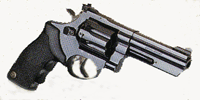
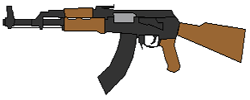
WEAPON is every mechanism which, by any propulsive force, launches a projectile, chemical substances, rays, flames or gases and may cause injury to persons, damage to property or fire; in particular every firearm, grenade, mine of any type and every device capable of producing those results. Weapons are mainly divided into rifled firearms, smooth-bore hunting guns and air guns. Rifled firearms have a barrel that is not smooth internally but bears helical rifling or grooves, of conventional or polygonal form, with right-hand or left-hand twist. Smooth-bore hunting guns are shoulder-fired single-barrel or double-barrel, repeating or semi-automatic guns with a smooth barrel and with length, barrel length, magazine capacity and purpose as defined by law. In Greece they have traditionally been a frequent means in criminal acts.
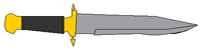
Also notable are weapons disguised as another object. Such concealed weapons may be factory-made or improvised, such as pen guns and key-holder weapons. Air guns operate with compressed air or carbon dioxide and launch a pellet made of metal, plastic or another material. In addition, under Law 2168/93, weapons also include objects suitable for attack or defence, such as chemical-spray or electric-discharge devices, knives not justified by lawful use, knuckledusters, clubs, nunchaku, swords, spears, bows, crossbows, police batons, incendiary or irritant/anaesthetic devices, spear guns, silencers, target-lighting devices, weapon sights and simulators, parts and accessories of weapons, explosive devices and ammunition, as well as firearm replicas that can be converted into real weapons or non-functioning firearms with essential defects.
AMMUNITION means every kind of firing supply, especially cartridges for military rifles, automatic weapons, firearms, pistols and revolvers, heavy-weapon and artillery projectiles, and systems consisting of explosives, explosive mechanisms or their combinations that can be used as they are or fired by weapons of direct or curved trajectory. Ammunition also includes its active or component elements, such as primers, cartridge cases, bullets and propellant materials, as well as cartridges of harmful chemical substances.
EXPLOSIVES are solid or liquid substances which, for any cause, undergo chemical transformation and become gaseous masses under high temperature and pressure conditions, producing ballistic or explosive effects. EXPLOSIVE DEVICE is any device capable of causing the explosion of any explosive substance.
Issues such as import, export, re-export, transit, manufacture, repair, assembly, trade, possession, carrying, transport and use of weapons and explosives, unlawful use of weapons, purposeless shootings, seizure, confiscation, permits, suitability of weapons, shooting ranges and related matters are regulated by the currently applicable Law 2168/93.
Laboratory Examinations ^
By applying internationally recognized, scientifically documented and court-admissible scientific and technical methods, we carry out laboratory and other examinations on objects and exhibits related to firearms and other weapons, with the purpose of:
On-site Inspection - Assessment - Utilization ^
In addition, we carry out:
Indicative questions that may be raised, depending on the case under examination ^
 |  |  |
