Forensic Investigation Consultant FIC
Forensic Investigation Consultant
FORENSIC EXPERT WITNESSES
FORENSIC ANALYSTS
Forensic Investigation Consultant FIC
Forensic Investigation Consultant
FORENSIC EXPERT WITNESSES
FORENSIC ANALYSTS
According to N. Poulantzas, Professor of Criminology at the University of Ottawa in Canada, Applied Criminology is based on observation, hypothesis, experimentation and reasoning. A good “investigator” is one who tests examination results obtained in accordance with established standards against commonly accepted logic, in order to draw and evaluate conclusions. Those conclusions derive from the study of the case file and from the results of laboratory examinations conducted on the findings.
Applied Criminology draws its principles from both science and art and, for greater precision, may therefore be described as a Scientific Technique.
On the basis of the above, our company possesses long-standing knowledge and experience in conducting and evaluating laboratory examinations. As regards the creativity of our imagination and our reasoning, we invite you to assess them through real cases.
Findings and exhibits, as carriers of reliable information, are all those elements—firearms, tools, traces, stains, etc.—found at the scene of an offence, on the suspect, on the victim or elsewhere, which may serve not only as proof that an offence was committed, but also as an indication of the accused person's guilt or innocence.
Although these elements are inanimate and cannot be questioned during the preliminary investigation, the main investigation or the court hearing, when they are properly handled and subjected to scientific and technical management, examination, analysis, interpretation, exploitation and evaluation, they can provide objective evidence and information. They may confirm, refute or reinforce a suspect's claims or a victim's testimony; associate or exclude cases or events; and connect a victim or suspect with a specific place, among other things.
These elements, known as “mute” or “silent witnesses”, have a comparative advantage over other means of proof, such as confessions and testimony: they are not subject to autosuggestion or suggestion by others, they do not forget, they cannot be coerced, they cannot be threatened and, most importantly, they cannot be bribed.
A forgotten fingerprint, invisible biological material, broken vehicle fragments, cartridge cases and bullets are, together with many other items, findings which, through appropriate processing and interpretation, can give decisive direction to the outcome of the cases under examination.
Today, reliance on scientific and technical proof is constantly increasing. When combined with a properly documented case file, such proof shapes judicial reasoning and, consequently, establishes the judicial judgment.
“Applied criminology presents the complexity of Law, the responsibility of Medicine and the universality of Science” Paul Kirk 1902-1970 |
Ballistics examines matters related to firearms, such as comparative examinations, ballistic investigations and other related matters, as well as the effects produced by their use, including ricochet, acoustics, gunshot residues, wound ballistics and other phenomena.
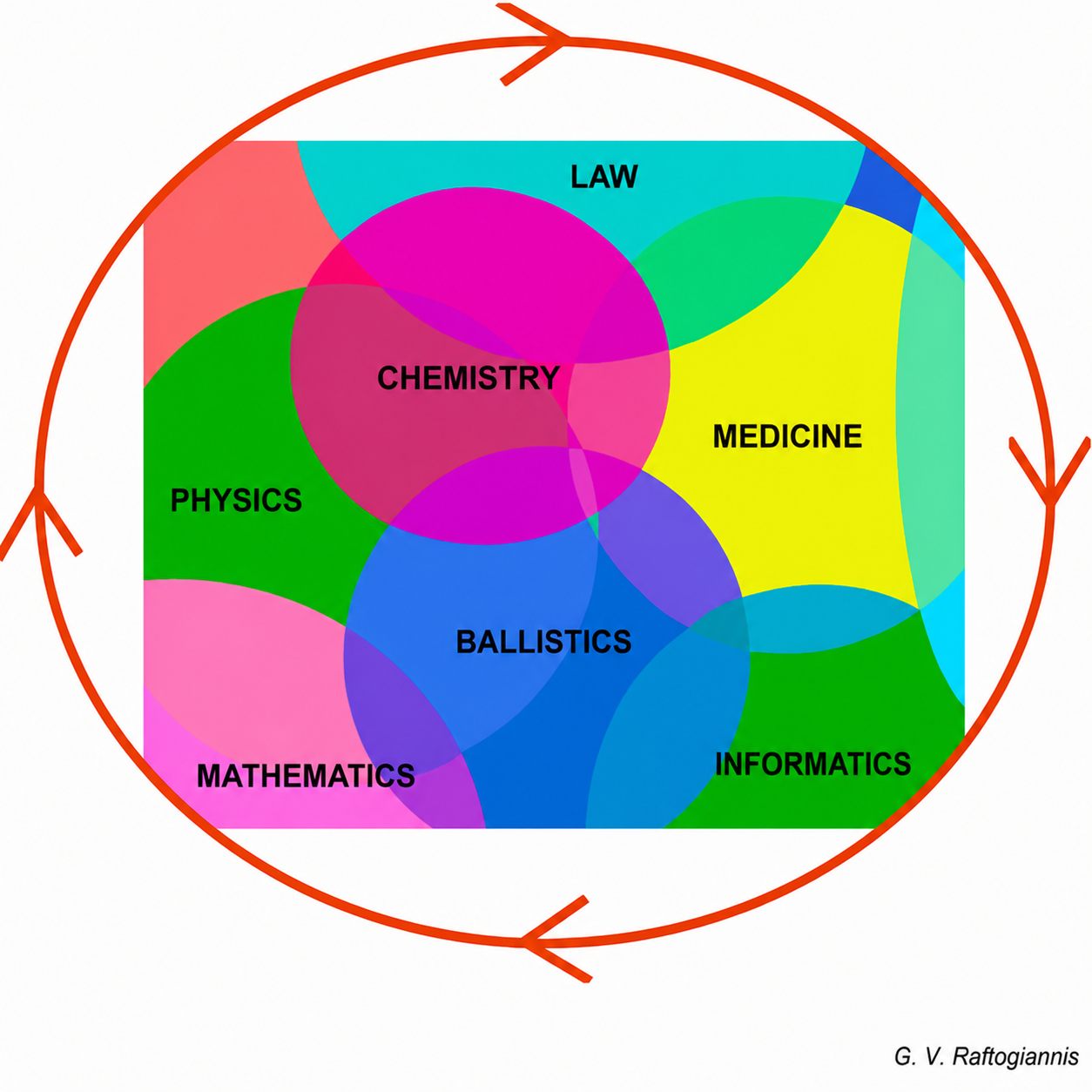
It is therefore one of the specialties of Applied Criminology. But what is Applied Criminology? Applied Criminology does not derive from a single scientific field; rather, it draws its principles from different scientific and technological fields. It embodies interdisciplinarity—a point of convergence among multiple scientific disciplines, namely the intersections of different fields of knowledge—and is therefore described as a Scientific Technique.
For example, in the field of medicine, interdisciplinarity is critical. An internist may need to order microbiological and imaging examinations for a patient. It is the physician who bears responsibility for deciding which examinations the patient will undergo and how extensive those examinations should be.
The ordered examinations are carried out by specialist microbiologists and radiologists, who may have no direct communication with one another. Nevertheless, the internist must jointly evaluate their results, taking into account the information obtained through the prescribed methodology and examinations, in order to reach an appropriate diagnosis and therapeutic strategy.
The ordering physician—in this example, the internist—is responsible for the judgment, the joint evaluation of the results and any decisions that must be taken. At the same time, the physician is a specialist in the relevant field of Medical Science.
If the ordering physician omits certain examinations or fails to evaluate them properly, this in no way constitutes the responsibility of the microbiologist or the radiologist.
Consequently, this is the gap that arises in cases of judicial interest: the need for the joint evaluation of the results and for a deeper examination of the full range of questions that should be posed in each individual case.
How, then, can this gap be filled? Through understanding and approaching the facts of each case from different perspectives.
This is why interdisciplinarity is continually gaining ground internationally over absolute specialization. In what respect? Not by diminishing scientific specialization, but in relation to the final Judgment and Decision-Making. Consider medical boards, as opposed to decisions taken unilaterally.
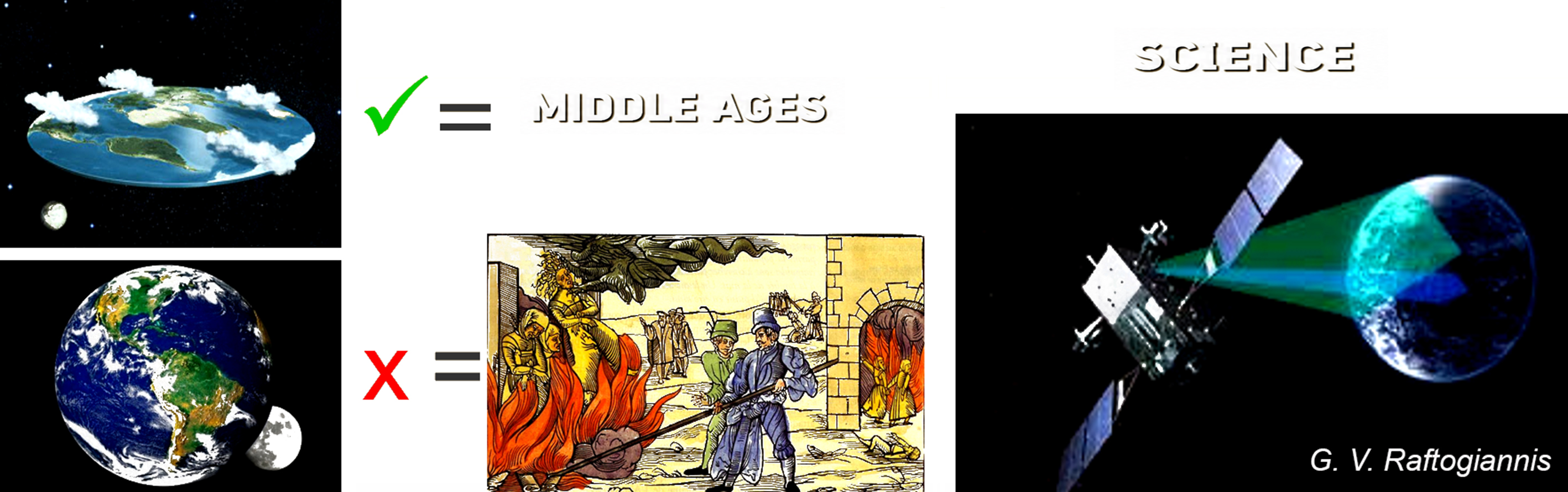
In the Middle Ages, the accepted truth was that the Earth was flat. Anyone who spoke of a spherical Earth faced the stake. Science, however, arrived with its satellites and revealed the spherical shape of the Earth—the one actual truth. In conclusion, we must all stand on the same side—not on the side of apparent truth, but on that of the one actual truth.
 |  |  |
| Address | : | 12 Dimokritou Street, Athens |
| Postal Code | : | 106 73 |
| Tel. | : | +30 210 3640061 |
| FAX | : | +30 210 3640051 |
| Mobile | : | +30 6944 473531 |


 Today1028
 Yesterday951
 This week4276
 This month15158
 All599660